A Whiteparish local history page from younsmere-frustfield.org.uk
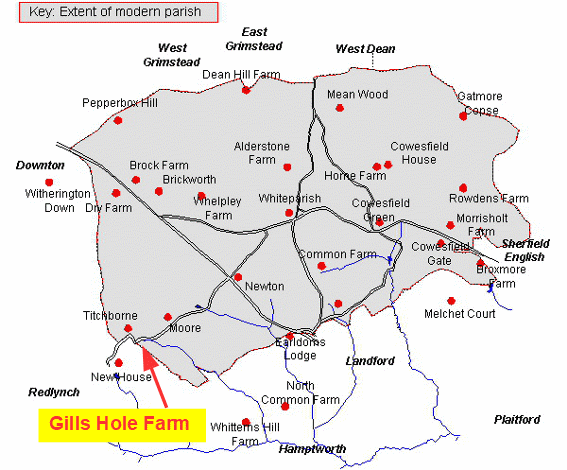
Gills Hole lies in the southwest of the parish between Moore and Titchborne. The map below shows the (yellow) areas forming the farm in 1842, with fields bearing the name Gills Hole Fields at that date also highlighted, in green. Together with the fields to the right of the green section alongside the drove road, these give the appearance of possibly having been part of a larger farm in earlier days. As described below the Newhouse estate dates from shortly before 1619, when the Gills Hole Fields were purchased from Titchborne Manor as part of this estate.
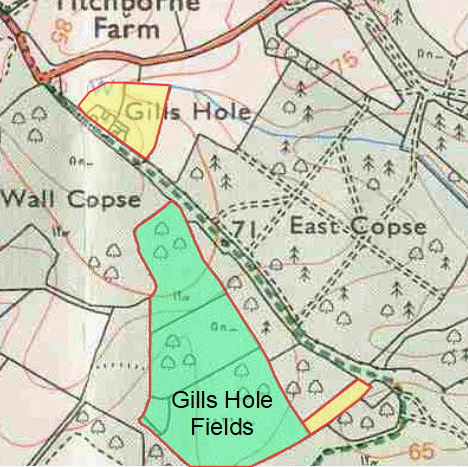
The extent of the landholding in 1842 (two yellow areas bordered by red)
The fields called Gills Hole Fields in 1842 labelled in green
The existing farmhouse is of 17th century date and was almost certainly built a short while before it was first recorded in 1689 [Taylor WAM Vol 62 1967 p96: Wilts CRO 130/17b].
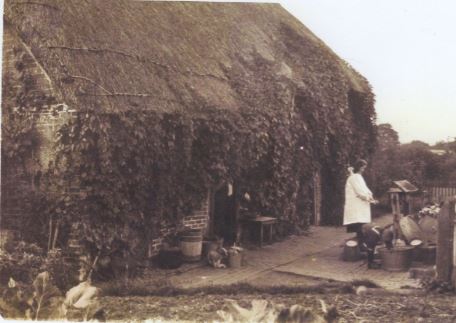
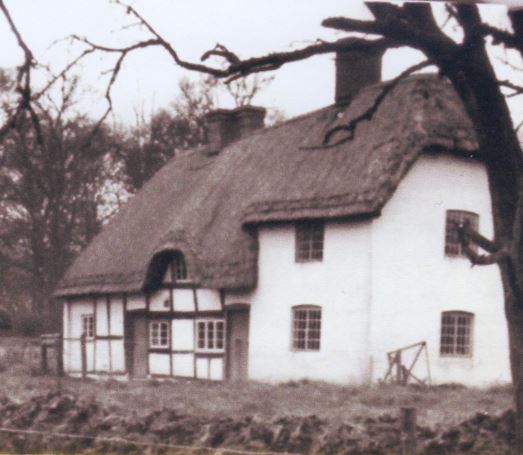
Gills Hole in the early 1900s (1957 WI scrapbook) and again in the late 1990s
Showing just how much the appearance of such buildings has changed in modern hands
Sadly, the roof of this pictureque house caught fire on 5th August 2018. The modern replacement is pictured here under construction on 29th December 2020. See this BBC report for three copyright pictures not visible below on the public version of this website.


The new house at Gill's Hole under construction, December 2020
The farm and surrounding fields were occupied by William Edney on the 1842 Tithe map, owned by Lord Nelson as part of the lands bought up for the family after Horatio's death in 1805 at Trafalgar. William also occupied another of Nelson's fields, 1054 Bungays Field, a few yards to the south, a total of 7 land parcels overall making a total of 4.74 acres and including a house and garden, yards and buildings and orchard. His smallholding was sandwiched between bigger neighbours. On Nelson's land Alfred Gay farmed Titchborne to the north and William Andrews farmed Moore to the east, while George Matcham owned and occupied the New House estate to the west and south, itself falling within Abbotstone (Titchborne) Manor.
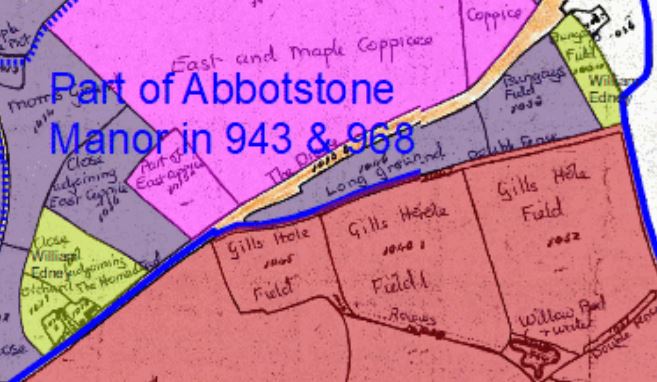
Gills Hole as farmed by William Edney on the 1842 Tithe Map (north to left of map)
William's holdings are bottom left and top right of the map in pale green
By 1842 when William Edney was farming Gills Hole, land in the area and the farm itself had been bought up by two large estates. George Matcham lived at Newhouse, whose boundary came up to the opposite side of the drove road alongside Gills Hole. Newhouse had been "lately erected" in 1619 on land sold by William Stockman to Sir Edward Gorges of Longford and the Whiteparish part of the estate was less than half of the total, which extended widely across the neighbouring parish of Redlynch. More recent boundary changes transferred the house and Whiteparish part of the estate into that parish. William Stockman bought and sold his way across the parish. In the reigns of Elizabeth and James I (1558-1603-1625) he held Titchborne Manor (Abbotstone), of which Newhouse and Gills Hole were both part, and progressively sold different sections of it. In 1627 Whelpley Manor was divided into the manor and the farm, and Joseph Stockman bought the farm (oddly including the manorial buildings at what is now Whelpley Farm). This series of sales and purchases explains the oddity of finding the present Abbotstone House on Whelpley Manor land as he owned the title to Titchborne/Abbotstone manor, but not to Whelpley manor. At the same time the title to Whelpley Manor was bought by the Eyre family to be part of the Brickworth estate, which features in the next paragraph.
The other estate was newer and was the land purchased by the government in 1813 by Act of Parliament for the Nelson family to extend the Trafalgar (Standlynch) estate. The land purchased in Whiteparish was strategically selected and covers most of that corner of Whiteparish that lies adjacent to the Brickworth estate already owned by the Nelson (Eyre) family and adjacent to land in Redlynch that bridges the gap between the Stanlynch estate and the Whiteparish boundary, thus forming a large contiguous estate across the two parishes. Two small areas were not purchased for the Nelsons, including Chapel Coppice (659 and 660a) owned by Robert Bristow, the owner and lord of the manor of Alderstone. Should one assume that he declined to sell part of the Alderstone estate? The other area was Hilly Field (667), which was already part of the Brickworth estate, having been purchased by the Eyre family. Frances Elizabeth Eyre inherited this in 1815 and married Thomas Bolton in 1821, so that when he became 2nd Earl Nelson in 1835 she became the Countess Nelson. Her Brickworth estate would automatically pass to their son Horatio Bolton, the 3rd Earl Nelson in 1878 on her death and thus become part of the Trafalgar (Standlynch) estate.
More useful detail can be seen in the (Crown Copyright) map below (not visible on the public version of this website for copyright reasons, but you can view it here: HistoricEngland. An easy way to locate Gills Hole on the map is to enter the reference for Titchborne Farmhouse, 1024005, then navigate very slightly south past the dogleg in the road and expand the scale.)

Detail of Gills Hole in 2019 (Crown Copyright) [source Historic England listed buildings]
Copyright prevents this being displayed on the public version of this website - there are instructions above on how to view this map
Gills Hole Farm.htm Copyright 2001-2023 Created 2001 Last updated 9.2.2023
A Whiteparish local history page from younsmere-frustfield.org.uk